How to Declutter After a Loved One Passes Away: 7 Gentle Tips
Inside: Use these gentle tips to help you declutter after a loved one passes away.
Decluttering can be a challenge. And making those decisions can be even more difficult when you’re grieving the loss of a loved one.
When people sign up for my newsletter, I ask them to share their decluttering challenges. A common theme in those responses has been the difficulty of managing the personal belongings of a loved one while grieving their loss.
And it’s quite a range of scenarios people have shared, from the loss of a spouse to parents to siblings and children.
While this is not the cheeriest of topics, it is a reality of life that everyone will likely face at some point. So, today I want to offer some gentle tips on how to declutter after a loved one passes away.

Proactively decluttering
Disclosure: As an Amazon Associate I earn from qualifying purchases. Please note that I only recommend products I use and love. Click here to read my full disclosure policy.
In an ideal world, everyone would have decluttered their belongings before they passed. The Gentle Art of Swedish Death Cleaning by Margareta Magnusson was written about this very thing.
In the book, Magnusson advocates for taking a proactive approach to the decluttering process.
The idea is to declutter now, not only to enjoy your home more but also to lessen the burden placed on family members after you’re gone. It can be a great motivator for proactively decluttering your home.
But in many cases, that is not the reality of what happens.
Some people don’t declutter because they are in poor health. Others simply really enjoyed their things and didn’t want to part with them. And other times, we just assume we have more time than we do.
No matter how you’ve come to be in this situation of dealing with someone else’s items, there are practical steps you can take as you declutter after a loved one passes away.

How to Handle Getting Rid of a Loved One’s Belongings
Some cultures do a better job than others in being able to openly discuss death as they recognize that it is part of life. In the U.S., we don’t do a great job at this.
Most people don’t want to talk or think about death in advance. However, the more we are willing to have these conversations and prepare for what’s to come, the better off we can leave our loved ones.
After losing a loved one, there are many emotions to process through. There are logistics to deal with in the midst of this. It can all feel rather overwhelming.
These practical tips will help you walk through how to declutter after a loved one passes away.
1. Figure out when you will go through things
First, you’ll need to figure out when the right time is to go through their things. There can be quite a variety of circumstances. If the person lived alone, you may need to deal with their belongings rather quickly.
If it is a spouse or another family member you live with, that’s a different situation for deciding when to go through things. There really isn’t a right or wrong answer, as it depends on your unique circumstances.
In some cases, I’ve heard about entire households being relocated to a storage unit, and that’s not something I would recommend. It becomes an expensive burden to have to deal with later.
I also wouldn’t suggest moving tons of belongings into a space that is already full, as that will also feel like a daily burden you’re surrounding yourself with. If the loss is someone in your household, the timing will vary depending on when you feel emotionally ready to deal with their things.
If you experienced an unexpected tragedy, have grace and patience with yourself as you navigate your journey. There is no set prescripted time.
Do what feels right for you, although I realize sometimes life circumstances force us to deal with things before we feel ready.

2. Decide who is going through the belongings
If you are in a situation where you and your siblings have a shared responsibility in managing an estate, discuss with the others involved when you plan to go through the belongings.
Sadly, this can be a time when family members struggle to agree on when and how to deal with things.
Always keep in mind that the only person you can control is you. Try to respond in a way that you can feel good about, regardless of how other people are behaving.
Ultimately, do your part to maintain peace if possible, and also realize that everyone deals with loss in different ways.
3. Ask for help, don’t take on the responsibility alone
When you are clearing a house after a loved one’s death, don’t go it alone. Have trusted family members and/or friends help you through the process.
It can be challenging to make decisions as you grieve, so having someone who can support you and offer perspective can be very helpful.

How to start clearing a house after the loss of a loved one
Now comes the challenging part. How do you decide what to declutter after the loss of a loved one? What do you do with their personal belongings? Here are some practical tips to help you get started.
Begin in a room with fewer sentimental items. The bathroom is a good option to start with. Likely, most of what you find in this room will get tossed in the trash unless you or a family member can use the overstock of toiletries.
The kitchen is another good option to do early on in the process, as decisions tend to be easier there. Go through the whole home by starting with the easiest rooms and working your way up to the most difficult.
Most people save the bedroom and storage areas for last. This is just a general guideline, so choose the order of rooms based on what you feel are the easiest to most difficult rooms for making decisions.
Sorting items into categories
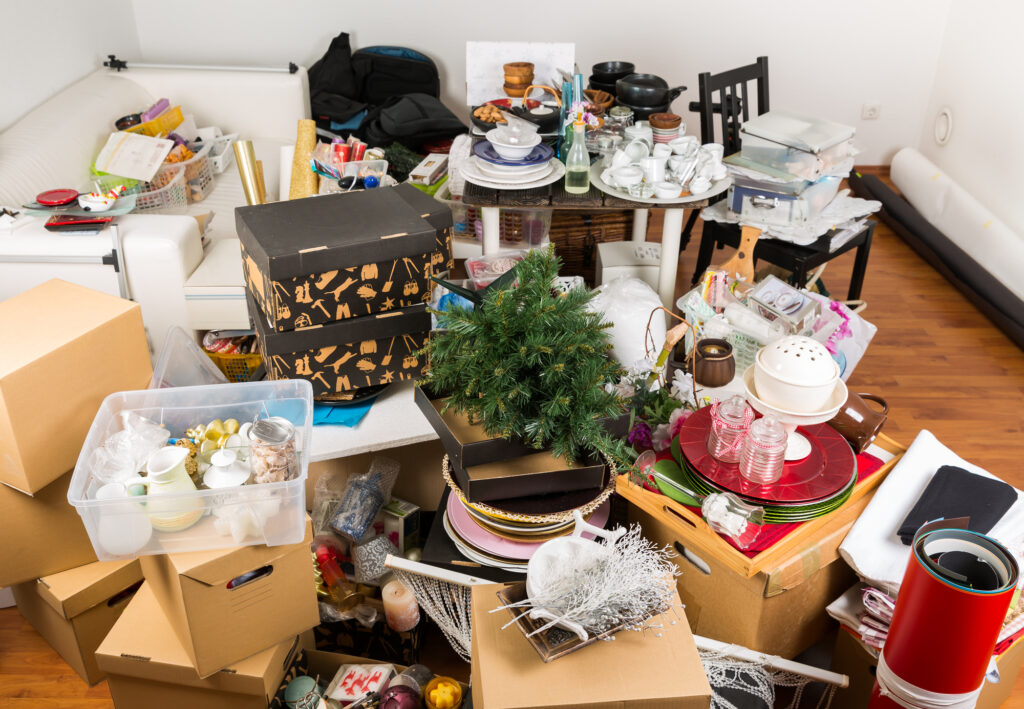
How to declutter after a loved one passes away is largely the same process as how you would declutter your own home. You’ll sort the items by what you are planning to keep, throw away, sell, and donate.
A big difference is that when you’re getting rid of a loved one’s belongings, your keep pile will be significantly smaller. More than likely, a large portion of what they own is not going to be something you need or have space for in your home.
4. What to keep when someone dies
Deciding what to keep when someone dies can be tough. In an ideal world, you could have thought through which items you want to keep before the time comes.
In the midst of grief, it can be challenging to separate the person from their things.
Letting go of their stuff may feel like you’re letting go of them, but keep this in mind. People are not their things. Your memories will not be any less real or meaningful because you don’t keep their belongings.
Keep a few select items that are the most important ones to you. If you are someone who is sentimental, it becomes even more important to have help and outside feedback through this decluttering process.
What couple of items remind you most of this person? What do you truly have room for in your home?
Not just as in can you cram it in somewhere, but is this something you will really be able to use or treasure in your home?
You don’t want to relocate a lot of excess items in your home for them just to weigh you down. In being very selective about what you keep, you can prevent the burden of extra stuff in your home.
Holding onto memories without keeping all of the stuff
Another way to keep memories without holding onto more stuff is by taking pictures of certain items you want to remember. Create a memory box with meaningful items and pictures that you can reflect back on.
There are other creative options, like having a quilt or throw pillow cover made with shirts they’d worn, if you want to reuse things in a meaningful way.
Don’t keep items out of a sense of obligation or guilt. And remember that even if you decide to keep something initially, it is ok later to decide to let it go.
Have grace and patience with yourself as you make decisions through your grief.

5. What to throw away after someone passes
After someone passes, throw away items that are broken or in bad shape. Get rid of used toiletries. Throw out the perishable goods unless you are realistically able to make use of them yourself.
If the items couldn’t be sold in a thrift store, then that’s a good indication it is something to throw away. Things like mattresses may not be able to be donated, but if they’re in good condition, they could be given away via your local Buy Nothing group.
6. What to sell in an Estate sale
If you are considering an estate sale, contact a company in the area that specializes in them. Estate sales are a lot of work and tend to be better handled by professionals.
It is one thing to have people try and haggle with you at your own garage sale, but it’s another when it’s your deceased parent’s items. Estate sales take a lot of time and emotional energy that may not be worth the effort.
Estate sale companies also know how to price items to sell, and it can take unnecessary pressure and work off of family members. Yes, they will take a portion of the proceeds, but it is still worth considering.
7. What to donate to those in need
What do you do with someone’s clothes after they die? I’d recommend donating most of it. If there is a special piece of clothing you want to hang onto, feel free to do so.
You could also consider if other friends, family, or organizations your loved one liked would have liked to support, that would be able to make good use of the clothing.
If you’re not doing an estate sale, then likely a lot of what that loved one owned would get donated to people in need. It feels good to donate to causes that mattered to the one who passed.

Decluttering after the loss of a loved one can be hard. Be gentle with yourself in the process.
It can be tough to know how to declutter after a loved one passes away. Remember to take a lot of deep breaths. It’s ok to feel sadness and grief and to go through a range of emotions throughout the process.
Don’t try to go through it all alone. Share how you are feeling and ask for help when you need it.
Do your best to be patient and kind with yourself as you work through letting go of the physical belongings.
Choose to honor that person through your life and how you live it, and treasure the happy memories that you shared. Their legacy can live on through what you learned during your time with them.
Stay up to date with simplifying resources
Want to keep up to date with The Simplicity Habit? Sign up on the form below and get weekly tips on simplifying and decluttering sent straight to your inbox. You’ll also get the free Declutter Plan of Attack to help you create your own unique decluttering plan for your home.

I am getting ready to retire, again. I am getting rid of everything! I will be homeless, on purpose! visiting family across the US. and then traveling abroad! I can’t wait!
I did have a little trouble with actual photos, any thoughts on how to let go?
There are businesses that will scan all your photos for you
Getting rid of the clothes of a lost loved one is very hard and many cannot do this too soon as the first stage of bereavement is DENIAL. Then crying and searching. Wondering where your loved one is coming back. Then the reality hits they are not coming home. Different for everyone. For me I had been in counselling for other issues which prepared me better to handle grief. Many people feel numb so I though whilst I am numb and before thawing out I will prepare all my husband’s clothes immediately. So that is what I did. I didn’t feel a things whilst gathering everything for charity. All gone. Then I dismanteled the clutter in the garage and that took longer, but I was making progress. I thought no use keeping items that cannot now be used. Better to pass on to other’s to bless their lives. I have no regrets. It worked out for me. Now 13 years later I am decluttering my own possessions whilst I still can. I was 77 yrs. of age yesterday and know I don’t have many years left and as I am housebound with a disability I cannot wear the clothes I loved. So this is my present task. We all have different stages of greiveing and for each of us this will be different. A person will know within themselves when to perform this task of disposing of their lost loved one’s clothes and other belongings. You just know When to do this. A sort of gut feeling. So just be gentle with the experience and task in hand.
I am so sorry for your loss. Thank you for sharing your thoughts. My husband is in poor health and I have mentioned clearing out some things but he hates that idea. I know clothing will be so painful but I like your idea of doing it in the numb period. When the time comes, clearing out will be sooner for me as I will have to move from a 2 bedroom apartment to a 1 bedroom apartment due to finances. Your response was very helpful.
Lost my Dad in 2017 and my Mom still grieves. She will all the days of her life I’m sure. She ended up with a triple bypass in 2022 and I know it was mostly grief induced. Our family is large so for her, when she decided to get rid of his things. She kept the most sentimental that were things they shared between them and then strangely she kept his hygiene products still in their place and a special cup he used all the time. His clothes, we made pillows for children and grandchildren after that she has kept most the rest or at least the ones he wore a lot, but I think now that my son is older, she has been talking about him coming and going through Pappy’s shirts because he is now the same size as my dad was when he passed. He grew into his jeans quicker and so has already since worn them out. Dad’s tools and such are still in the workshop and the boys still use them from time to time when they need something. Truly I think she has only gotten rid of the things that she had to actually see all the time. But gave them away to family members as keep sakes. So, in a way she still has a lot to deal with, but I think what she has gotten rid of, it was easier because she had family to give it to and would know it would be cherished. It’s hard but I see no need to pressure her about it. Once she passes it’ll be for me and my sister to go through. But it’ll just have to be a bridge we cross when we get there. And who’s to say we’ll outlive her… Death is no respecter of person’s…
This is what I am struggling with the most. Husband passed two years ago and still have not gone through all his clothes and personal items. Just feels heartbreaking to let go but I know I must do it at some point. I did start with his sock drawer. He had so many socks. Trying to get his old coats and long sleeve shirts and some pants ready to donate to charity as winter is almost here. Definitely have to take it slow and one step at a time.